
How to Choose a Summer Camp for Your Child (From a Parent Who's Vetted a Lot of Them)
It's the middle of summer. Your kid is at camp this week, and somewhere in the back of your mind you're already wondering if you'll pick the same one next year.
Maybe this week is going great. Maybe you showed up for pickup on day two, and the counsellor at the gate looked at you, then looked around, and genuinely had no idea where your kid was.
I hear that story a lot.
Camp is one of those decisions parents make fast, usually back in January, or even back in the fall for bigger camps, often based on what's convenient or what a friend's kid did. Then you spend the summer finding out whether you got it right.
And if you're reading this because this summer isn't going the way you hoped, you haven't failed at anything. You've just learned something about your kid. That's useful. Use it.
Because you don't have to guess next time. There's a way to think this through before you ever open a registration form, and it starts with your kid, not the camp. I'm going to walk you through what actually matters. At the end I'll tell you about the camp my son Luke asks for by name every single year, and why it earns that.
Start with your kid, not the brochure
Every camp website says the same thing. Fun. Friendship. Confidence. An "unforgettable summer." It all blurs together.
So don't start there. Start with the kid in front of you.
Watch what your child does when nobody is telling them what to do. That's the whole secret. The kid who won't get off their bike. The kid narrating stories to their stuffies for an hour. The one taking the remote apart to see what's inside. Whatever they reach for on their own is where their energy naturally wants to go, and a camp that leans into it almost always lands better than one you chose because it looked impressive on paper.
Then think about where they already shine. Camp is a great place for a kid to feel good at something. If your daughter is a strong swimmer, a week where she gets to be one of the confident ones will do more for her than a month of you telling her she's amazing. Kids remember the summers they felt capable.
And here's the part parents skip. Think about what your child is still working on.
Not to fix them. To grow them somewhere that feels like play instead of homework. If your kid freezes up in the water, the answer isn't a loud, chaotic pool with forty other kids in it. It's a small, structured program where the fear gets to turn into pride over a couple of weeks. Same kid, completely different outcome, and the only thing that changed was the setting you put them in.
Once you can describe your child in a couple of honest sentences, what they love and what they're quietly working on, every other decision on this list gets easier.
The one I actually need you to pay attention to: safety
If you skim the rest of this, don't skim this part.
I hear the same stories from parents over and over, and they're the ones that stay with me.
A mom shows up at pickup and the counsellor has no clue who her child is, or which adult he's supposed to leave with. A dad walks in at 2pm and sees it right away. Kids wandering with no real supervision. No plan. Staff on their phones. Nobody actually tracking who is where.
It's usually not that anyone means harm. It's that there's no structure. And no structure is exactly where kids get hurt.
Good safety isn't a feeling you get from a nice website. It's a set of systems you can ask about before you hand over a deposit. So ask.
What's the ratio of staff to kids, and does it get tighter for swimming or field trips? For little ones and anything near water, you want more eyes, not fewer.
How does pickup actually work? There should be a real sign-out system and a list of who is allowed to take your child. "We know the parents" is not a system.
Will the staff know my kid by name? In a well-run camp, your child is in a consistent group with consistent counsellors who know his name and his allergies on day one.
What training do the counsellors have? Ask about first aid, CPR, water safety if there's a pool, background checks, and how new staff get supervised.
What happens in an emergency? Where's medication kept, who gives it, who calls you, and how fast.
What do they do with a kid who wanders off, or melts down, or won't join in?
A camp that welcomes these questions and answers them specifically has already thought about your child before you walked in. A camp that gets vague or a little annoyed is telling you something too. Believe them.
How long should it be? And should you camp-hop or commit?
Camps come in every length. One week. Two. The whole summer. There's no right answer for everyone, but there's a right answer for your kid.
Camp-hopping, stringing together different weeks all summer, gives your child variety and a chance to try things they'd never pick on their own. For a curious kid who gets bored fast, that can be a summer of discovery. The catch is that every new week is a new first day. New drop-off nerves. New faces and new rules, plus a new set of safety standards you have to check all over again. For a kid who takes a while to warm up, that Monday reset is hard, and they might never get to the good part, the part where they've settled in and made a real friend.
Committing to one camp for a longer stretch does the opposite. The magic is consistency. The staff genuinely get to know your child, which, like I just said, is a safety win as much as an emotional one. Your kid builds real friendships instead of starting over every week. He settles into a rhythm. He usually gets noticeably better at something because he isn't constantly beginning again. The trade-off is less variety and a bigger upfront cost, and if it turns out to be a bad fit, you're more locked in.
The question to ask yourself is simple. Does my kid light up at new and different, or does my kid relax when they know exactly what's coming? Both are completely normal. Build the summer around the answer.
Personality is the thing most parents forget
This is the one that can make or break a summer.
A big, high-energy day camp with a new activity every forty minutes is heaven for some kids. The outgoing one who's always asking "what's next?" will thrive in that buzz.
Put a highly sensitive kid in that same camp, and it can flatten them. The noise. The constant switching from one thing to the next. For a nervous system that feels everything at full volume, it's just a lot. That kid usually isn't "not a camp kid." They're not a big-camp kid. Give them a smaller, focused program with a calmer rhythm and one thing to sink into, and you might find out they love camp after all.
So think about how your kid is wired.
The sensitive or shy child usually does better with a smaller group and a predictable day, focused on one thing instead of a firehose of ten.
The kid who genuinely cannot sit still needs a camp built around moving and being outside, not one that expects long stretches of sitting quietly. For these kids, movement isn't a break from the day. It's how they get through the day.
The kid who's obsessed with one thing often blooms at a camp devoted entirely to it, where they get to go deep and feel like the expert in the room.
The slow-to-warm kid does better going back to the same place and the same people, which is one more point in favour of staying put over hopping around.
There's no wrong kid here. There's only a camp that fits and a camp that doesn't.
A few more things worth checking
Once you've got the big four sorted, these help you narrow it down.
Specialized or general. A general camp gives variety and lots of different kids to meet. A specialized camp gives depth and a real sense of "I got good at this." Match it back to what you learned about your kid at the top.
Day camp or sleepaway. If you're weighing an overnight camp, the question isn't really age, it's readiness. Has your child done sleepovers away from you and been okay? Can they speak up when they need something? Plenty of kids aren't ready until ten or eleven, and some are ready at eight. There's no prize for sending them before they're set.
The actual logistics. Be honest about the drive, the drop-off and pickup windows, and whether there's before- or aftercare. The perfect camp that's forty minutes away can quietly eat your whole July and your mental health. For me, that’s a non-starter.
What it really costs. Look past the sticker price. Are lunch, equipment, and extended care included or extra? Ask about sibling discounts and the refund policy, because kids get sick and plans change.
Whether they can actually support your kid. If your child has allergies, ADHD, or a learning difference, ask straight out how they handle it. A good camp answers you with confidence, because they've done it before.
Who else is going? For some kids, walking in with a buddy is the whole difference between dread and excitement. For others, a place where nobody knows them yet is exactly the fresh start they want. You know which one you've got.
What other parents say. Read reviews, but pay most attention to the parents whose kids are like yours. And ask the camp how many staff come back each year. Counsellors who return summer after summer are one of the quietest, best signs of a camp that's run well.
Why my son asks for Pedalheads every single year
Full honesty, before I say one nice thing, I'm a parent ambassador for Pedalheads this year. However, the order matters here. They didn't turn my son into a fan. My son is the reason I said yes to being a parent ambassador because he'd been begging to go back long before any partnership existed. So when I run Pedalheads through the same checklist I just gave you, it holds up. That's why I'm comfortable putting my name on it.
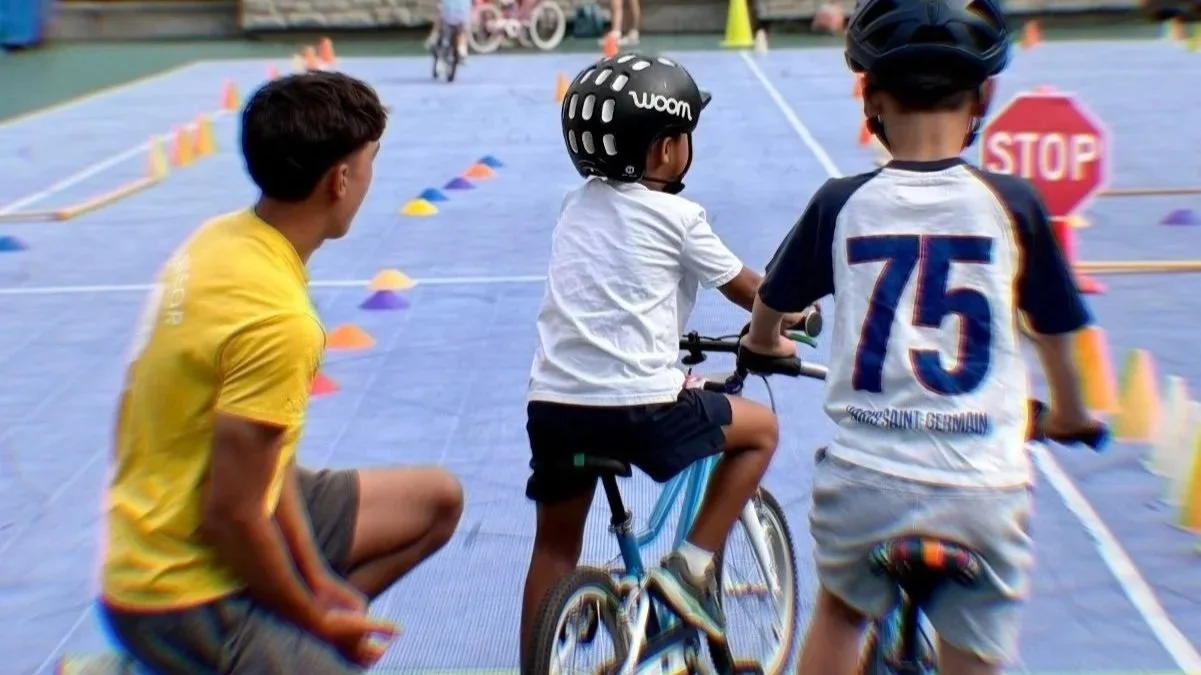
It's focused. Pedalheads isn't thirty activities crammed into one day. It's biking, swimming, and/or trail riding, with a real level system that moves kids from training wheels to riding safely on the road. For my son, that focus is everything. He isn't overstimulated, he's locked in. And there is nothing like watching your kid clear a level and realize, all on his own, that he can do something this week he couldn't do last week, or in our case, yesterday. He earned that confidence himself, and it sticks.
The safety is exactly what I tell you to look for. Helmets and road skills are embedded right into the biking, and water safety into the swim. The classes stay small enough that the instructors actually know the kids in front of them. They're high energy, and they're paying attention, and because the whole thing is built around a progression, there's always a plan for what each kid is working on. None of that aimless wandering I warned you about. Every summer, I am routinely impressed by the quality of the staff at the camp and the fact that so many are repeat counsellors. Wondering about pick-up procedures? You have an assigned number which you have to be able to provide every single time you pick up your child. Every. Single. Time. “I’m his mom” isn’t going to fly, and frankly, I don’t want it to. I witnessed one dad livid that he was being asked for a code, and I was so impressed by the calmness of the 19-year-old counsellor who stood their ground and said, “Well, that’s my protocol; no kid without the code. We haven’t met before, and I have no idea who you are, so I’m not going to release a child without knowing with certainty that I’m handing them over to an approved guardian.” This is the type of system I wish every camp had in place.
Lastly, it fits how kids are actually built. It gets them outside, moving, and off the screen, which every kid needs and the can't-sit-still kids need badly. Pedalheads has been doing this since 1986. They've run programs for more than 700,000 kids across 400-plus locations, and parents rate them 4.8 out of 5 across thousands of reviews. That track record is the reason their safety and their systems aren't something they're figuring out as they go.
The real test, the only one that counts in my house, is that my son asks for it by name. Not "can I do a camp this summer." "Can I do Pedalheads again?" He comes home worn out in the best way, proud of something specific, already talking about next summer.
If you want to give it a try, here’s a $50 discount for your first session of camp or lessons.
So here's where I'll leave you
Choosing a camp doesn't have to be a shot in the dark you take in January and hope about until August.
Start with your kid. Ask the hard questions about safety, and don't apologize for a single one of them. Pick a length that matches whether your child craves variety or craves knowing what's coming. And match the place to their personality, so camp becomes somewhere they get to feel most like themselves.
Do that, and you're not just filling a few weeks off school. You're giving your kid a place to get a little braver and a lot more sure of who they are. That's what the right camp does. And you'll know you found it, because your kid will be the one asking to go back.
Which camp did your kid ask to go back to this summer? Tell me. I read every reply.